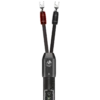

Technical Specifications
- Solid Perfect-Surface-Silver (PSS) Conductors
- Perfect-Surface Technology applied to extreme-purity silver provides unprecedented clarity and dynamic contrast. Perfect-Surface Silver (PSS) is AudioQuest’s highest-quality metal. Solid conductors prevent strand interaction, a major source of cable distortion. Extremely high-purity PSS minimizes distortion caused by the grain boundaries that exist within any metal conductor, nearly eliminating harshness and greatly increasing clarity compared to OFHC, OCC, 8N and other coppers.
- ZERO-Tech (No Defined Characteristic-Impedance)
- Carbon & PSS Silver Based Linear Noise-Dissipation
- The world is permeated with RF Noise from satellites, cellular towers, Bluetooth, etc. AQ’s comprehensive Linear Noise-Dissipation employs multiple shields, absorptive carbon, direction-controlled metal, and Perfect-Surface Silver (the best possible RF conducting shield-drain) in order to prevent RF Noise from compromising amplifier performance.
- ZERO-Tech
- The only complete way to eliminate characteristic-impedance mismatches between a cable and the attached source and load is for the cable not to have any fixed characteristic-impedance value. ZERO-Tech accomplishes this by eliminating interaction between the insulation (dielectric) and the cable’s conductors—enabling uncompressed current transfer. All-important transient current is unrestricted, and RF Noise-Dissipation is linearized (consistent octave to octave).
- 72v Dielectric-Bias System (DBS) with Level-X RF Noise-Trap
- Insulation is also a dielectric that acts like a shunt-filter. Properly biasing the dielectric linearizes the filter, significantly improving the cable’s wide-bandwidth ability to dissipate induced noise. The DBS pack’s Level-X Noise-Trap “pulls” RF Noise out of the cable, further reducing attached audio circuit misbehavior.
- Terminations
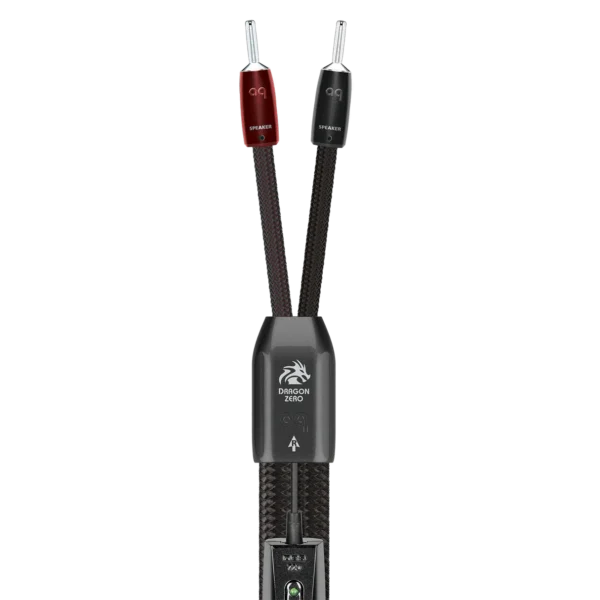
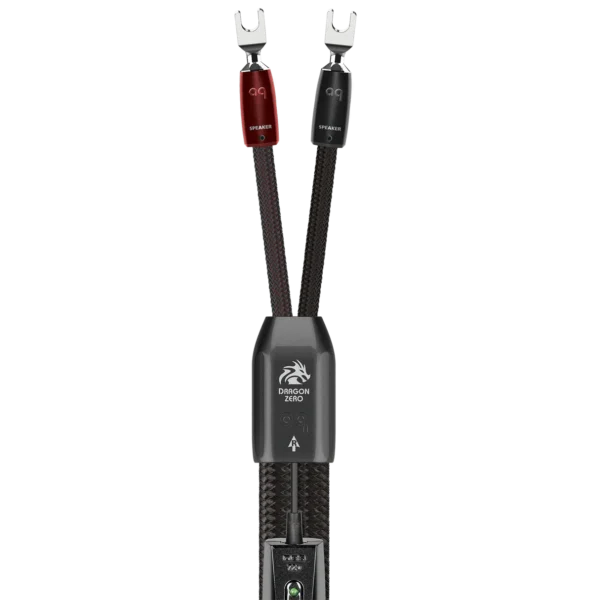
- Dragon cables are Cold-Welded to AudioQuest’s extremely pure Red Copper Spades or Bananas. The bare copper is submerged (hung) in a vat of pure silver instead of being tumbled in a lower-grade solution. AudioQuest speaker breakouts and plug casings are not metal in order not to induce RF Noise into the conductors.
- Bi-Wiring
- When possible, running separate cables to the treble and bass “halves” of a speaker considerably reduces distortion. Bi-Wiring keeps the large magnetic fields associated with bass energy out of the treble cable, allowing the delicate upper frequencies to travel a less magnetically disturbed path, like taking the waves out of the water when you swim.
- AudioQuest Bass and GND-Tech (patented Ground-Noise-Dissipation) attracts RF energy away from the amplifier’s output. When properly implemented, Bi-Wiring has always been a cost-effective way to get better performance for the same or less money. With GND-Tech, the advantage of Bi-Wiring is much more dramatic.
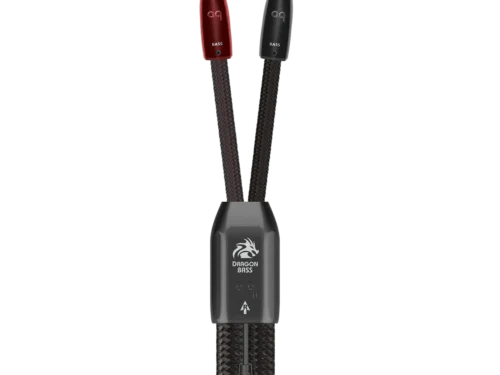
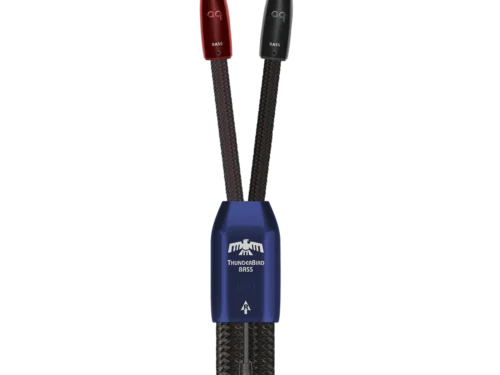
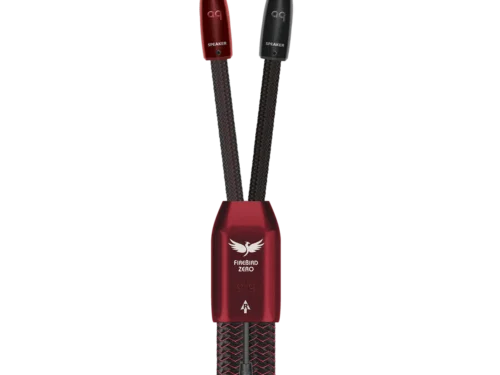
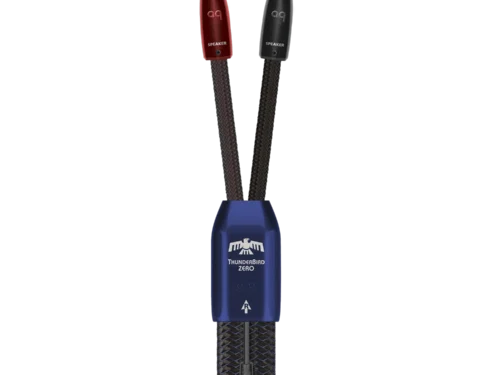
- Dragon BASS cable is ideal for the Bass input of a Bi-Wire-able speaker in combination with a Dragon ZERO on the treble input. A Bi-Wire COMBO with BASS and ZERO cables joined together at the amplifier is usually the most convenient. When Tri-Wiring, use BASS cables on the Midrange and on the Bass inputs.
- Caution: Do not Bi-Wire with two ZERO cables. Two or more ZERO cables in-parallel can create a very high-Frequency resonant peak (ringing), and resulting poor sound. On a Bi-Wired speaker, only use ZERO in combination with a BASS cable, otherwise us a single ZERO cable with jumpers.